


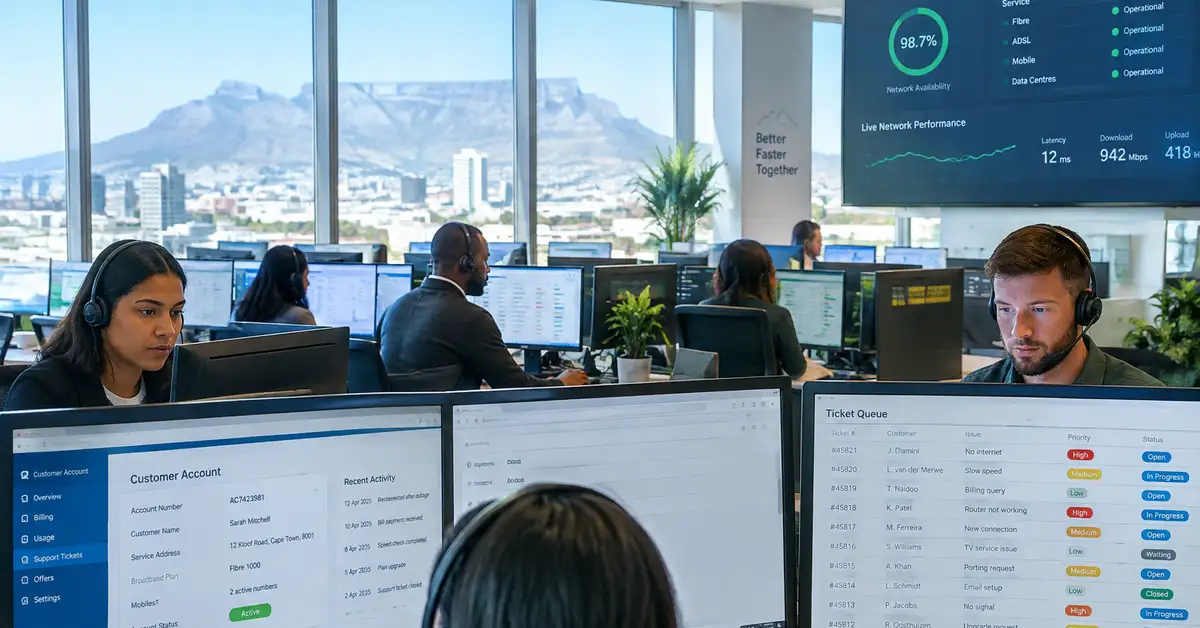
For a UK telecoms provider of 50 to 300 people, an offshore team is worth building for the work your customers judge you on: answering them, fixing their faults, getting their orders live and billing them correctly. That is where a mid-sized altnet, ISP, MVNO or business reseller is compared with the largest providers, and where, in our experience, UK hiring is slow and expensive. Our pattern for that work is consistent: customer-facing work in South Africa, technical and back-office work spread across Iași, Bengaluru and São Paulo, and every regulatory decision kept with you.
Key takeaway
Customer service, complaints, technical support, provisioning, billing, network monitoring and data all suit an embedded offshore team. Put UK-facing voice work in South Africa, 1 hour ahead of the UK in British Summer Time and 2 in winter, where a standard local day runs from 8am to 5pm UK time in summer and 7am to 4pm in winter; use Iași, Bengaluru and São Paulo for service desk, network and back-office work, with agreed shifts for any hours outside the standard day. Ofcom's rules, telecoms security duties, UK GDPR and PECR apply wherever the team sits and responsibility stays with you, so design the controls first.
Why are UK telecoms providers building offshore teams now?
The public benchmark for service keeps improving. Ofcom's latest quarterly figures put complaints to the regulator about the major broadband providers at six per 100,000 customers in January to March 2026, the lowest since its records began and down from a peak of 40 in 2011. For the most complained-about broadband provider, complaints mostly concerned faults, service and provisioning, complaint handling and billing: the same areas a smaller provider has to staff well to compete on service.
The clock on complaints is also shorter. For complaints raised from 8 April 2026, customers can go to alternative dispute resolution after six weeks instead of eight, or sooner if the complaint reaches deadlock. Ofcom's own analysis found that 79% of complaints at the biggest providers were resolved within a week and 94% within six weeks, so a backlog now reaches ADR sooner.
For altnets, growth now means connections: INCA and Point Topic's State of the Altnets 2026 puts altnet coverage at 19.7 million premises at the end of 2025 and live connections above 3.5 million, up 32% in a year, with customer acquisition the sector's top concern. Every new connection brings orders, installs, faults and bills.
The National Living Wage rose to £12.71 an hour in April 2026, from £11.44 two years earlier. Ofcom's research shows 4% of telecoms customers missed a payment in a single quarter, so collections needs care. And on 25 September 2026 Ofcom warned against providers' AI tools becoming gatekeepers that block access to support, noting many customers still value a person for complex or sensitive issues. Automation will take some volume; the rest needs trained people.
Which telecoms functions suit an embedded offshore team?
The functions that move well are high-volume, process-driven and already measured: in telecoms, most of customer operations.
| Function | What the embedded team handles | Roles we staff | Where we would build it |
|---|---|---|---|
| Customer service and complaints | Calls, chat and email on accounts, moves, upgrades and service issues; logging and investigating complaints to your complaints code; escalating to your UK team at the points you set | Customer service consultants; customer operations | Cape Town, Johannesburg |
| L1 and L2 technical support | Fault diagnosis and line tests, router and connection troubleshooting, raising and chasing faults with your network partner, business customer tickets | L1 and L2 service desk analysts; infrastructure support technicians | Iași, Bengaluru, São Paulo, Cape Town, Johannesburg |
| Provisioning and order management | Order validation, appointment booking and confirmation, order tracking, number porting admin, keeping customers updated on install dates | Customer operations; admin support | Cape Town, Johannesburg, São Paulo, Iași |
| Billing and accounts receivable | Bill queries and corrections, payment allocation, business account collections, supplier invoices | AR clerks for payment reminders and collections administration; AP clerks | Any of the five hubs |
| Network monitoring and application support | Alarm monitoring and first response, incident logging, support for your billing, CRM and provisioning systems | Network engineers; application support analysts | Bengaluru, Iași, São Paulo |
| Data and reporting | Churn and retention analysis, complaint and fault trend reporting, regulatory returns preparation, data cleansing | Data analysts; BI developers | Any of the five hubs |
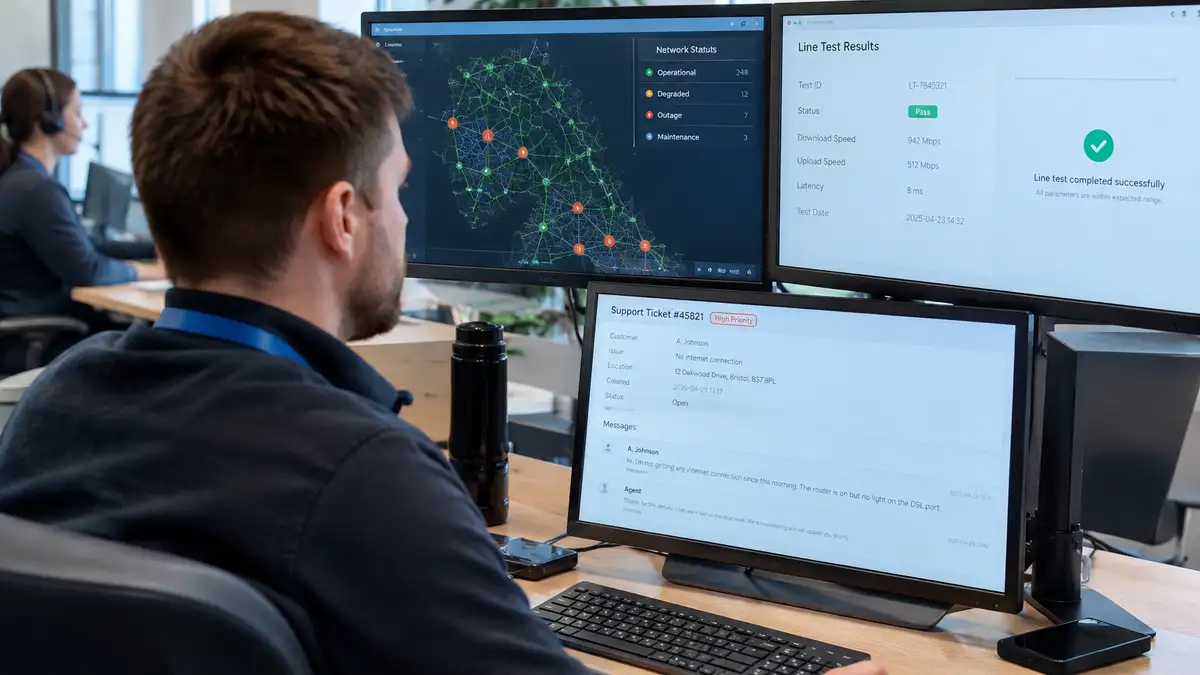
Two parts need more care. Complaints investigation moves well once your complaints code is a written playbook with clear escalation points. Residential collections often involves customers in financial difficulty, so the team works to your affordability and vulnerability policies and hands over cases needing a UK judgement.
Keep onshore: field engineering, network design and change approval, wholesale negotiations and your relationship with Ofcom.
Which hub suits which telecoms function?
For daily phone work with UK customers, South Africa is our first choice: English-speaking and used to UK businesses. For technical, network and back-office work, the hubs differ in depth and in which end of the UK day they cover.
Iași is strong in L1 and L2 service desk, network engineering and application support, with European languages if you serve customers outside the UK. Bengaluru is the largest engineering pool we recruit from, with ITIL-aligned service desk, network and data roles. São Paulo adds service desk, network engineering and customer operations. Systems administrators and network engineers take 2nd line and escalation support. We also build SOC analysts and security engineers in any of our hubs, including an offshore security operations centre, subject to the telecoms security duties below.
On cost, in our experience labour cost savings typically run at 30 to 50% against the UK in Cape Town and Johannesburg and 40 to 50% against Western European rates in Iași. In São Paulo, operating costs for equivalent roles typically run 30 to 50% below the UK, and in Bengaluru salaries often run 40 to 70% below the UK, especially for mid-to-senior roles. The ranges are measured on different bases, so they do not rank the hubs against each other. For technical teams, see our guide to the best offshore location for a technology or MSP team.
How do you cover UK hours, evenings and weekends?
Residential customers call in the evening and at weekends, so plan cover against your contact profile before you choose a location. The table converts a standard 9 to 6 local day in each hub to UK time.
| Hub | Offset from the UK | A 9 to 6 local day in UK time |
|---|---|---|
| Cape Town and Johannesburg | 1 hour ahead in British Summer Time, 2 in winter | 8am to 5pm in summer, 7am to 4pm in winter. Covers the UK morning and most of the afternoon. |
| Iași | 2 hours ahead all year | 7am to 4pm all year. Strong for the UK morning. |
| Bengaluru | 4.5 hours ahead in British Summer Time, 5.5 in winter | 4.30am to 1.30pm in summer, 3.30am to 12.30pm in winter. Covers the early UK morning and finishes around lunchtime. |
| São Paulo | 4 hours behind in British Summer Time, 3 in winter | 1pm to 10pm in summer, 12pm to 9pm in winter. Covers the UK afternoon and evening. |
South Africa is 1 hour ahead of the UK in British Summer Time and 2 in winter, so cover after 5pm UK time in summer, or 4pm in winter, needs an agreed later shift or a second hub. For a provider answering until 8pm, we usually recommend covering the evening for technical support or order management from São Paulo, which is 4 hours behind the UK in summer and 3 in winter, so its standard day runs to 10pm UK time in summer and 9pm in winter. Weekends and nights need an agreed shift pattern in any hub. For monitoring beyond the standard day, the table shows how Bengaluru and São Paulo extend it; overnight, weekend or continuous cover is designed with you around your service levels, subject to the security duties below. Our guide to offshore NOC and technical support teams covers monitoring cover in more depth.
What does Ofcom and UK data law require when the team is offshore?
Ofcom's General Conditions set standards for the work that apply wherever the team sits. Ofcom is explicit that when a provider uses third parties, compliance remains the provider's responsibility. These are the points we plan around for any telecoms team. They summarise risk; take your own legal and regulatory advice on how they apply to your services.

- Complaints handling (General Condition C4). If you serve consumers, small businesses with up to ten employees or small not-for-profits, you must follow Ofcom's approved complaints code, keep written complaint records and belong to an ADR scheme. The offshore team works to your code, with deadlock letters and the ADR point (six weeks for complaints raised from 8 April 2026) built into its case management.
- Vulnerable customers (General Condition C5). You need clear, effective policies for treating vulnerable customers fairly, and Ofcom's guide of measures covers customers in debt. Train the team to identify and record vulnerability and use your handover routes, and audit calls against it.
- Billing and unpaid bills (General Condition C3). Bills must be accurate, and steps to recover unpaid bills must be proportionate, with a warning before any service interruption. Your AR and collections playbook needs to reflect that.
- Automatic compensation. If you are signed up to Ofcom's voluntary automatic compensation scheme for residential landline and broadband, customers currently receive £10.34 for each calendar day a lost service is not fixed after two full working days from the fault report, £32.31 for an engineer appointment missed or cancelled with less than 24 hours' notice, and £6.46 for each calendar day a new service starts late. Give your fault and provisioning team those targets.
- UK GDPR international transfers. The ICO's guidance uses a customer services team in India with access to UK systems as its example of a restricted transfer. Where we employ the team it is a separate legal entity, so the rules apply. Romania is covered by UK adequacy regulations, so no IDTA or transfer risk assessment is needed, though other UK GDPR duties apply. South Africa, India and Brazil need a safeguard such as the International Data Transfer Agreement, with a transfer risk assessment.
- PECR. Traffic data, such as call records, may only be processed for set purposes, including billing, customer enquiries and fraud prevention, by the provider or a person acting under its authority. Scope the team's access to those purposes. For retention or sales calls, PECR's marketing rules, including Telephone Preference Service screening, apply to calls you instigate wherever the caller sits.
- Telecoms security. Under the Electronic Communications (Security Measures) Regulations 2022, a network provider must take appropriate and proportionate measures so that it could, if necessary, operate its network without reliance on people or data outside the UK, and network monitoring tools must not be accessible from China, Iran, North Korea or Russia. Assess offshore network monitoring against these duties first, and keep operational control and a UK fallback in place.
Where offshoring goes wrong in telecoms
The failures we see come from handing over a process without the standard behind it: a team that has never read the complaints code, collections calls made without the vulnerability policy, or broad system access granted to save time. Training, scoped access and call audits agreed before go-live reduce all three risks.
Why an embedded team rather than an outsourced contact centre?
An outsourced contact centre supplies capacity against a service level, with the staffing, management and procedures set by the contract; individual contracts vary. An embedded offshore team is dedicated to you, works in your CRM, ticketing and billing systems, follows your complaints code and escalation routes, and reports into your managers. We handle the employment, the office, local management and HR. The table sets out where the two models differ.
| What matters to a telecoms provider | Outsourced contact centre (typical) | Embedded offshore team |
|---|---|---|
| Who manages the people day to day | The vendor's supervisors | Your managers |
| Who applies your policies in a live case | Vendor staff, working to the contract's terms | Your team, escalating to your managers |
| Systems and data access | Agreed in the contract, sometimes on the vendor's tools | Your systems, with access you scope and can revoke |
| How a change reaches the front line | Through the vendor's management | Directly from your managers |
What this looks like in practice
Kane International, a Hertfordshire manufacturer of emissions testing equipment, was losing customer service candidates to higher-paying London employers. We started with a pilot of two customer service consultants in Cape Town, recruited against Kane's own standard and trained on its products. The team grew from two to nine within twelve months, and Kane has since added procurement and finance roles. In 2024 Kane held a 94% rating on Trustpilot, which scores customer satisfaction with a 1-to-5-star TrustScore based on recent reviews. Kane's senior manager, once against offshore staffing, now calls the team an extension of the Hertfordshire office. You can read the Kane case study in full.
On the technical side, we build service desk teams for UK managed service providers, working inside their ticketing and monitoring tools to their escalation rules. The same approach suits a telecoms provider's L1 and L2 support: see offshore service desk teams for MSPs and the service desk migration playbook. For billing and AR, see offshore finance and accounting teams; for another regulated market, offshore teams for energy and utilities.
The decision in four questions
- Which function hurts most today? Start there with a pilot of two or three roles. In our experience it is usually first-line customer service or fault handling.
- When do your customers contact you? Map contact volumes by hour, then match hubs to them. Use the hours table above; evenings, weekends and nights need agreed shifts or a second hub.
- Is your process written down? Your complaints code, vulnerability policy, collections rules and escalation points become the team's playbook, so write down whatever is not.
- Is the data and regulatory design done? Settle the transfer mechanism, network security assessment, access scope and call audit plan with your advisers before anyone starts.
For more depth on each hub, read our location guides.
Frequently asked questions
Can a UK telecoms provider use an offshore customer service team and stay compliant with Ofcom's rules?
Yes, provided the team works to your complaints code, vulnerable customer policies and billing rules, and you can evidence that it does. Responsibility for compliance stays with you, including when third parties are involved. Train the team on your procedures, audit its calls and take advice on how the rules apply to your services.
Where should a UK telecoms provider build an offshore customer service team?
For UK-facing voice work, South Africa: Cape Town and Johannesburg are 1 hour ahead of the UK in British Summer Time and 2 in winter, so a standard local day covers 8am to 5pm UK time in summer and 7am to 4pm in winter. If you need multilingual support for customers in Europe, build the team in Iași. Bengaluru and São Paulo suit service desk, network and back-office work.
How do offshore telecoms teams cover evenings and weekends?
Offshore telecoms teams can cover evenings and weekends through agreed shift patterns or a second hub in a complementary time zone. São Paulo is 3 hours behind the UK in winter and 4 hours behind in summer, so its standard working day extends to 9pm and 10pm UK time respectively. Bengaluru, on India Standard Time (GMT+5:30), can support a follow-the-sun model, so work continues after the UK team finishes and turnaround times come down. For overnight and weekend cover, shift patterns and handovers are agreed around your operational requirements.
Does giving an offshore team access to customer data count as an international transfer?
Yes, where the team sits in a separate legal entity outside the UK, which it does when we employ it. Romania is covered by UK adequacy regulations. South Africa, India and Brazil need an appropriate safeguard, such as the International Data Transfer Agreement, with a transfer risk assessment.
How long does it take to build an offshore telecoms support team?
In our experience, hiring typically takes four to six weeks in Cape Town, Johannesburg, Iași and Bengaluru, and four to eight weeks in São Paulo, from starting the search to the candidate accepting the offer. We see the UK equivalent take six to twelve weeks or longer. Allow time for product, systems and complaints training before go-live.
Planning customer operations capacity for next year?
Talk to us about which functions would move well, which hub fits each, and the controls your regulator and customers expect.
Sources: Ofcom, telecoms and pay-TV complaints, January to March 2026 (July 2026); Ofcom, quicker complaints resolution (July 2025); Ofcom, rules for phone and broadband providers (updated April 2025); Ofcom, automatic compensation: what you need to know (updated July 2026); Ofcom, consumers using AI to help manage their telecoms services, but human contact still valued (25 September 2026); Ofcom, switching and affordability (September 2026); ICO, a brief guide to international transfers (January 2026); PECR 2003, regulation 8; INCA and Point Topic, State of the Altnets 2026 (March 2026); Electronic Communications (Security Measures) Regulations 2022, SI 2022/933; GOV.UK, National Living Wage rates.
