


Offshore sales teams allow mid-sized UK companies to scale revenue 3-5x faster by expanding sales capacity at 40-60% lower cost than domestic hiring. For COOs and CEOs navigating a fractured talent market and rising operational costs, this isn't a compromise: it's strategic architecture. We've scaled this playbook across 60+ portfolio companies, from JHA (now part of Accenture) how EnergyQuote built an offshore sales engine to EnergyQuote, and the pattern is clear: when designed correctly, offshore sales teams outperform domestic-only models.
The context is stark. 73% of UK employers struggle to find skilled talent, and the cost to hire and retain a sales representative in London or Manchester now exceeds £50K base salary plus 15% employer National Insurance. Time-to-hire stretches to 45-60 days, and time-to-productivity can be 3-6 months. Attrition is relentless: one in three UK workers plans to change jobs this year. Meanwhile, your revenue targets don't move. Offshore sales teams solve this equation without the recruitment theatre, cost escalation, or attrition risk.
Why Are UK Companies Turning to Offshore Sales Teams?
Three forces converge to make offshore sales teams the rational choice for mid-market growth.
The UK Sales Hiring Crisis: A Sales Development Representative (SDR) in the UK commands £35-46K base salary, plus 15% employer National Insurance (now increased from 12%), 3%+ pension contributions, and recruitment fees of 15-25% of first-year salary. For a £40K SDR, your all-in cost is £58-64K year one, before tech spend, management overhead, and onboarding. Recruitment alone takes 45-60 days; productivity ramp takes 3-6 months. A comparable offshore SDR in South Africa or Romania costs £9-15K base, with total employment cost around £12-18K annually.
Attrition and Retention Risk: UK job vacancies remain elevated, and sales talent, especially SDRs and Account Executives, face constant headhunting. Voluntary turnover in UK sales roles now averages 25-30% annually. Every departure costs 3-4 months of replacement time and £15-25K in recruitment fees. A distributed offshore team, properly managed, sees 12-15% annual attrition, and replacement is faster because your team has built recruitment pipelines and knows your playbook.
Capacity at Speed: Suppose you need to hire 5 SDRs and 2 Account Executives in Q2. In the UK, you're competing with 200+ other growth companies for the same talent pool, negotiating on salary, benefits, and equity. Your hiring close rate is 40-60%. Offshore, with the right partner, you're sourcing from talent pools of 100,000+ qualified candidates. You can hire a team of 7 in 6-8 weeks, fully onboarded and productive by week 12. The revenue ramp is 8-12 weeks faster than domestic hiring.
What Does an Offshore Sales Team Actually Look Like?
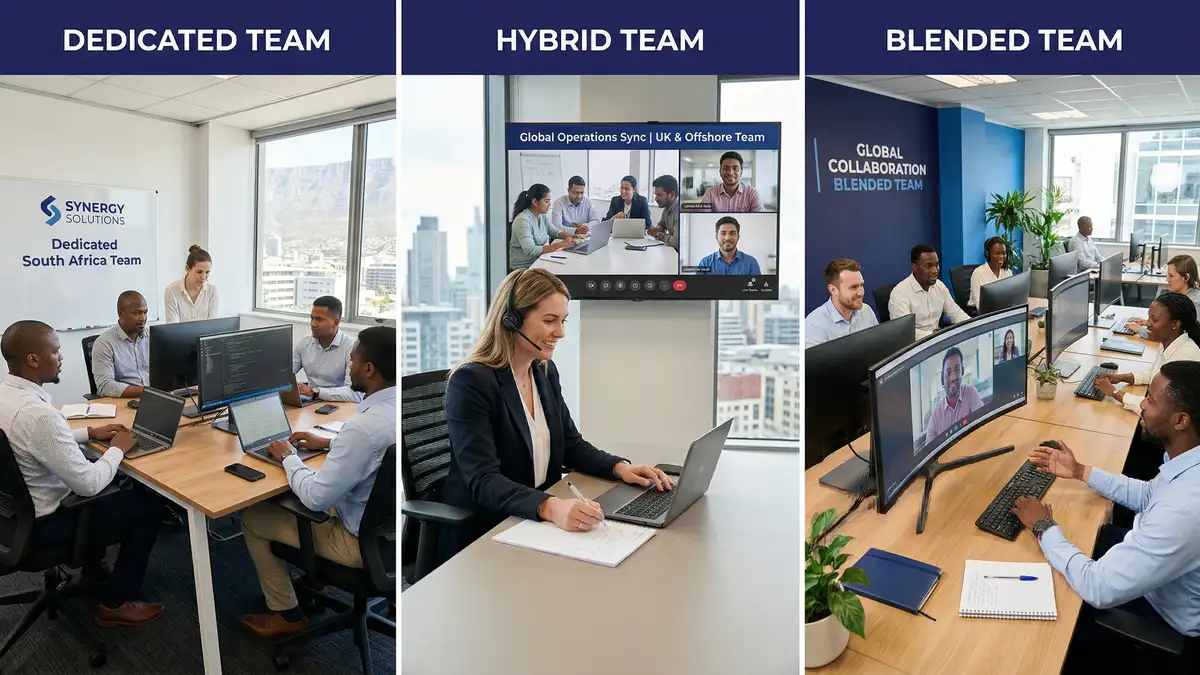
"Offshore sales team" is an umbrella term hiding three distinct models. Understanding the difference is critical because the wrong model tanks productivity and cultural fit.
Model 1: SDR/BDR Hub. This is the most straightforward deployment. Your offshore team (typically 3-8 SDRs and BDRs) works within defined territory, industry, or account segments to generate, qualify, and hand-off leads to your UK-based Account Executives. They operate to your playbook, use your CRM, follow your call scripts, and report to your sales operations manager. This model works because the handoff is transactional and the SDR output is measurable (calls made, conversations booked, qualified pipeline). It requires less cultural integration and lower management overhead.
Model 2: Embedded Account Management. This is Potentiam's bread and butter. Your offshore team (typically 2-5 Account Executives, CSM or renewal specialists) owns SME account segments or renewal books directly alongside your UK team. They attend the same all-hands, sit in the same Slack channels, work to the same KPIs, and report to your sales leader. They're not a "BPO vendor". They're permanent extensions of your sales organisation, compensated with base + variable (tied to revenue), given the same enablement and pipeline support, and treated as equals. This model requires stronger cultural alignment, better management infrastructure, and higher trust. It delivers 85-95% productivity parity with UK teams and enables you to scale revenue, not just pipeline offshoring sales and marketing for 10x performance growth.
Model 3: Customer Success and Expansion. Your offshore CSM, onboarding specialist, or renewal manager owns customer touchpoints: onboarding calls, quarterly business reviews, expansion conversations, renewal negotiations. This is particularly powerful in SaaS and subscription businesses where 50-70% of revenue comes from retention and expansion. The offshore CSM operates from your account management playbook and reports on the same KPIs as your UK team.
Potentiam's multi-hub model lets you choose which geography and team structure fits your needs. South Africa excels at the embedded model (strong cultural fit, English-first, 1-2 hour time zone overlap). Romania is powerful for EU-adjacent companies and compliance-heavy roles. India delivers technical depth for sales operations and data enrichment. Brazil offers Spanish/Portuguese capability for Latin American expansion.
How Much Can UK Companies Save with Offshore Sales Teams?
The unit economics are powerful. Here's a detailed cost comparison across regions:
| Role | UK | South Africa | Romania | India |
|---|---|---|---|---|
| SDR | £58-64K | £12-15K | £14-18K | £9-12K |
| Account Executive | £65-85K | £18-24K | £20-28K | £15-20K |
| Customer Success Manager | £35-48K | £10-14K | £11-16K | £8-11K |
| Sales Manager | £55-72K | £16-22K | £18-25K | £12-17K |
All figures are annual fully-loaded cost (salary + tax + benefits + contributions). UK figures include 15% employer NIC. Offshore figures include country payroll tax and standard benefits.
After accounting for management overhead (typically 1 HRBP per 15-20 offshore staff), shared technology (CRM, Slack, video conferencing, sales enablement tools), and Potentiam's delivery fee (all-in), net savings range from 35-55% compared to domestic hiring. For a team of 5 SDRs and 2 Account Executives (9 total), annual savings exceed £200K while actually increasing sales capacity and reducing attrition risk.
How Do Embedded Offshore Sales Teams Outperform Traditional Outsourcing?

Here's where the playbook matters most. "Offshore sales team" doesn't mean outsourcing to a vendor who treats your team as a transaction. Traditional BPO outsourcing (where sales reps work for the vendor, follow vendor processes, and rotate between clients) delivers 60-75% productivity parity. Embedded offshore teams, where reps are integrated into your organisation's structure and incentives, hit 85-95% parity or better.
Embedded Model vs Transactional Outsourcing
Potentiam's HRBP model operationalises this difference. Each offshore team gets a dedicated Human Resources Business Partner (HRBP) who manages payroll, compliance, local labour law, performance management, and cultural integration. Your offshore reps are full-time employees of the local entity (in South Africa, Romania, India), not Potentiam vendors. They're compensated with base + variable, given the same training and enablement as your UK team, and measured on the same KPIs. The result: your offshore team behaves like your team.
The most common reason offshore sales teams underperform is siloing. Your UK team and offshore team operate on different processes, use different KPIs, communicate asynchronously, and feel like separate companies. This breeds attrition (offshore reps leave because they don't feel "part of the team"), cultural friction, and poor lead quality (SDRs hand off weak leads because they're not measured on downstream conversion). Solve this by integrating from day one: same Slack, same all-hands, same sales meetings, shared incentives.
Learn more about our approach: Explore Potentiam's Sales and Customer Service Solutions to see how we embed teams into your organisation.
What Sales Functions Work Best Offshore?
The best offshore sales functions are those with clear process, measurable output, and lower dependency on real-time cultural context. SDRs prospecting and qualifying leads, CSMs managing SME renewals, and sales operations handling data: these are high-confidence offshore wins. Complex deal closing and senior account management are hybrid plays: offshore support (research, qualification, follow-up) with UK-based closes and relationship-building.
Sales Development (SDR/BDR): This is the highest-conviction offshore play. SDRs work to a defined playbook: identify targets, make outreach calls, run sequences, qualify opportunities, and pass to Account Executives. The process is repeatable, output is measurable (calls, conversions, qualified pipeline), and the role doesn't require deep customer context. Offshore SDRs often outperform UK peers because they're less likely to get pulled into non-core work and maintain disciplined activity metrics. A team of 4-6 offshore SDRs can generate 200-300 qualified conversations per month at 40% lower cost than UK hiring.
Account Management for SME Segment: If your SME segment (contracts under £50K ARR) has standardised sales cycles and repeatable outcomes, embedding 1-2 offshore Account Executives is powerful. They own the SME book, manage deals £15-50K, handle renewals, and drive expansion. This works because the sales cycle is shorter (30-45 days), negotiation is less complex, and the customer relationship is tied to outcomes, not executive presence. We've scaled this at IN-SYNC Group, where offshore AEs own 15-20 SME accounts each with 92% retention and 35% net expansion.
Customer Success and Renewal Management: Offshore CSMs are high-impact. They run onboarding calls, conduct quarterly business reviews, identify expansion opportunities, and manage renewals. In SaaS, this role drives 50-70% of revenue. Offshore CSMs operating to your playbook deliver 90-95% parity with UK teams. Cultural fit matters here too. You want a CSM who understands your customer base, but the mechanics are repeatable and outcomes are measurable.
Sales Operations and CRM Administration: Your offshore team can own data enrichment, CRM hygiene, reporting, forecasting support, and pipeline analytics. This frees your UK sales team to focus on selling. Offshore operations specialists are cost-effective here and often bring stronger technical discipline than domestic hires.
Enterprise Account Management (Hybrid Model): Can an offshore AE close a £200K+ enterprise deal? Rarely alone. But can they run the prospecting, qualification, technical discovery, and stakeholder mapping? Absolutely. The hybrid model (offshore AE running 80% of the sales cycle, with a UK-based executive closing the final stages) combines offshore cost efficiency with enterprise relationship-building. This works for competitive, complex deals.
How Does South Africa Compare to Other Offshore Sales Hubs?

When we talk offshore sales, four geographies dominate: South Africa, Romania, India, and Brazil. Each has distinct strengths. Here's how they compare:
| Hub | English Proficiency | Time Zone (GMT) | Cost Range (Annual) | Cultural Fit | Best For |
|---|---|---|---|---|---|
| South Africa | Native/Near-native | GMT+2 (1-2hrs) | £9-15K | Very High | Embedded teams |
| Romania | Fluent (formal) | GMT+2 (1-2hrs) | £11-18K | Very High | EU/compliance-heavy |
| India | Fluent (Indian accent) | GMT+5.5 (4-5hrs) | £8-12K | High (tech context) | Tech talent, operations |
| Brazil | Good (Portuguese/Spanish fluent) | GMT-3 to -2 (3-5hrs) | £10-16K | High (Latin America) | LATAM expansion |
South Africa: The default choice for UK and European companies. Cape Town has a mature BPO ecosystem how offshoring to Cape Town fuelled Grove's rise (270,000+ employees in the BPO industry) with strong supply of English-first talent, neutral accents, and proven process discipline. Time zone overlap is 1-2 hours (Cape Town is GMT+2, London is GMT), so your offshore team can overlap with your UK morning. Cultural fit is typically very high: South African professionals understand Western business norms, have experience with UK and US companies, and are motivated by opportunity. A Potentiam Cape Town team feels like your team from day one.
Romania (Iași Hub): Increasingly popular for EU-adjacent companies and compliance-heavy work. Romania is an EU member state, which simplifies GDPR and data protection (no extra contractual safeguards required). Iași has a strong tech and operations talent pool, fluent English-speakers, and slightly lower cost than South Africa. Time zone overlap is good (GMT+2, same as UK summer). Cultural fit is high: European context means shared understanding of regulations, working hours, and business culture. Best for: companies handling EU data, regulatory-heavy processes, or building teams for EU customers.
India (Bengaluru Hub): The largest talent pool and lowest cost, with deep technical expertise. Indian talent excels in sales operations, data enrichment, technical discovery, and anything requiring analytical depth. Time zone overlap is 4-5.5 hours (Bengaluru is GMT+5.5), which creates an asynchronous working pattern but enables 24-hour cycle time. English fluency is very high, though cultural fit requires more intentional integration. Indian business norms differ from UK norms. Best for: high-volume SDR teams, sales operations, tech-heavy roles, and companies comfortable with asynchronous collaboration.
Brazil: The growth play for Latin American expansion. Brazilian talent is fluent in Portuguese and Spanish, understands Latin American business culture, and offers competitive cost (£10-16K annually). Time zone overlap is 3-5 hours depending on season. Best for: companies building Spanish-speaking SDR teams or customer success teams serving Latin America. A Potentiam Brazil team can run your Mexico, Colombia, and Argentina pipeline.
For most UK companies, South Africa or Romania are the starting point. They offer the best combination of cost, cultural fit, time zone overlap, and talent supply. Explore our South Africa hub, Romania hub, or India hub to learn more.
What Does It Take to Build a High-Performing Offshore Sales Team?
Building a high-performing offshore sales team is a 16-20 week sprint, not a flip-the-switch moment. Here's the proven playbook:
Strategy and Role Definition (Weeks 1-2)
Define what you're offshoring: which sales function (SDR hub, embedded AEs, CSMs), how many headcount, which geographies, what KPIs. Create role descriptions, compensation plans (base + variable if embedded), and interview criteria. This clarity prevents costly misalignment later.
Talent Acquisition (Weeks 3-6)
Partner with Potentiam to source candidates. We screen against your criteria, run interviews (often with your team), and present finalists. Hiring cycle is 4 weeks vs 45-60 days for UK recruitment. Offers include visa/work permit sponsorship where needed.
Onboarding and Integration (Weeks 7-14)
8-12 week onboarding programme covering: company culture, product deep-dive, sales playbook, CRM training, first customer calls (observed). Add your team to their Slack channels, invite them to all-hands, pair them with UK mentors. This is where embedded teams separate from transactional vendors.
Governance and Integration (Weeks 15-18)
Establish weekly 1:1s with your sales leader, monthly business reviews with Potentiam, shared forecasting and reporting, and compensation reviews. Offshore team attends your quarterly sales kickoffs and annual offsites. KPIs are transparent; compensation is tied to outcomes.
Optimisation and Scaling (Week 19+)
Monitor KPIs weekly. After 16 weeks, you have enough data to understand productivity patterns, pipeline quality, and team strengths. Double down on what works (expand headcount, new segments) and adjust what doesn't (role design, compensation, enablement). Compound your wins.
Technology Stack: Your offshore team needs: (1) your CRM (Salesforce, HubSpot, Pipedrive); (2) Slack or Teams for communication; (3) video conferencing (Zoom, Google Meet); (4) call recording and AI (Gong, Chorus, or Airgap); (5) shared enablement platform (Lessonly, Seismic, or Guru). All of these integrate seamlessly with offshore teams. The tech debt isn't building new systems: it's ensuring your offshore team has the same tools and access as your UK team.
Potentiam's Proven Playbook: We scaled this model at JHA (now part of Accenture), growing from a UK-only team of 8 sales professionals to a 300+ person organisation with 60% of the team offshore. We've perfected the playbook: sourcing, onboarding, governance, performance management, and scaling. Learn about our team and track record.
How Do You Manage GDPR and Data Compliance with Offshore Sales Teams?

This is the question that stops most UK companies. Understandably. You're handling customer data (their emails, phone numbers, company names, sometimes transaction history) and transferring it to teams outside the UK. Is that allowed? The short answer: yes, with proper safeguards. Here's how it works by region:
South Africa: The UK Information Commissioner's Office has recognised South Africa as having "adequate protection" under data transfer laws. This means UK companies can transfer personal data to South Africa without extra contractual safeguards, provided data processors (Potentiam and your South Africa-based offshore team) follow UK GDPR principles. In practice: your offshore SDRs can access your CRM, see prospect names and emails, and run call sequences. You need: (1) Data Processing Agreement with Potentiam; (2) clear data retention policies (e.g., "delete prospect data after 6 months of no contact"); (3) team training on GDPR principles. South Africa's approach to data protection aligns closely with UK/EU standards, making this straightforward.
Romania: The simplest case. Romania is an EU member state and fully bound by GDPR. Data transfers to Romania face no legal friction: they're treated like transfers within the UK. Your offshore team in Iași operates under the same GDPR rules as your UK team. This is why many European companies prefer Romania for regulatory-heavy work.
India: The most complex. India is not recognised as having adequate protection. Data transfers to India require explicit contractual safeguards: Standard Contractual Clauses (SCCs) between you and Potentiam, and between Potentiam and individual team members. SCCs are boilerplate EU/UK regulations, but they add process overhead. In practice: you can transfer personal data to India, but you need tighter documentation. India is still viable if your business case is strong (cost savings, talent, time zone), but requires more legal rigour.
Brazil: Similar to India. Brazil has ongoing negotiations with the EU on data adequacy but isn't recognised yet. Data transfers require SCCs. Again, viable but with more contractual overhead.
Potentiam's Compliance Framework: We handle GDPR as standard for all teams. We maintain Data Processing Agreements compliant with UK GDPR and EU GDPR (where relevant), conduct annual security audits, provide team training on data handling and consent, and maintain audit logs of who accessed what data and when. Your offshore team has the same data security obligations as your UK team: password protection, two-factor authentication, data minimisation, and no unauthorised sharing. We also document data retention policies, for example, "prospect data deleted after 6 months of inactivity" or "customer contact history retained for 3 years post-contract".
The bottom line: offshore sales teams are fully compliant with GDPR when properly structured. The key is choosing a partner (like Potentiam) benefits of using managed services for offshore teams who takes compliance seriously, maintaining clear data transfer agreements, and training your teams on data handling principles. Don't let compliance fears stop you from building an offshore sales engine. Just do it thoughtfully.
Frequently Asked Questions
How quickly can an offshore sales team start generating results?
A properly onboarded offshore SDR team can generate pipeline within 8-12 weeks. Expect: first booked meetings by week 6-8, qualified pipeline by week 10-12, measurable velocity by week 16. This is actually faster than UK hiring (16-20 weeks to first pipeline) because recruitment timeline is shorter and you're deploying a team with proven playbooks, not ramping individuals from scratch. Embedded Account Executives take 12-16 weeks to full productivity because deal cycles are longer and customer relationship building takes time.
Are offshore sales representatives as effective as UK-based reps?
When properly integrated (embedded model), offshore reps hit 85-95% productivity parity with UK peers. For SDRs, offshore often outperforms because the role is process-driven and metrics-based. For Account Executives and CSMs, parity depends on cultural integration and account complexity. Your offshore AE will own SME accounts as effectively as your UK AE but may struggle with complex enterprise deals requiring executive presence. The key variable is structure and integration, not geography.
What size company benefits most from offshore sales teams?
Mid-market companies (£5M-50M ARR, 50-300 employees) see the best ROI. Smaller companies (under £5M ARR) benefit from offshore SDRs but may lack the sales infrastructure to support larger teams. Enterprise companies (over £50M ARR) often have mature UK sales teams but still benefit from offshore CSMs and customer success. The sweet spot is companies with defined sales processes, repeatable buyer personas, and clear role definitions.
How do you maintain quality control with an offshore sales team?
Quality control happens through: (1) clear role definitions and KPIs (calls made, conversations booked, pipeline qualified); (2) call recording and AI analysis (Gong, Chorus) to track conversation quality; (3) shared forecasting and pipeline reviews with your UK sales leader; (4) weekly 1:1s and monthly business reviews; (5) customer feedback loops (NPS, conversion rates, customer satisfaction). Offshore teams should report the same KPIs as UK teams and be measured on outcomes, not activity.
Can offshore sales teams handle complex B2B sales cycles?
Partially. A complex enterprise deal with 6-9 month cycle, multiple stakeholders, and £200K+ contract is best closed by a UK-based executive. But the prospecting, qualification, technical discovery, and stakeholder mapping can be 80% owned by offshore AEs. The hybrid model (offshore AE running the sales cycle with UK executive closing the final stage) delivers cost efficiency and effectiveness. For SME B2B deals (6-12 week cycle, 1-2 decision makers, £20-50K contract), offshore AEs can own 100% of the cycle.
What is the typical ROI timeline for an offshore sales team?
ROI payback is typically 6-9 months. For example, a team of 5 SDRs + 2 Account Executives costs £80-90K annually (all-in after Potentiam delivery fees), vs £320-350K for equivalent UK hiring. Cost savings alone (£230-260K) are realised immediately. Add revenue uplift (pipeline generated by the offshore team), and payback accelerates to 6-9 months. By month 12, the offshore team has paid for itself and is generating net incremental revenue.
Ready to Build Your Offshore Sales Engine?
Let's talk about your sales challenges. Book a 30-minute discovery call with a Potentiam consultant to explore offshore models, capacity, and ROI tailored to your business.
Potentiam is a strategic offshoring consultancy based in London. We build and scale embedded offshore teams for mid-market UK companies, from sales and customer success to operations and engineering. Our approach: dedicated hubs in South Africa, Romania, India, and Brazil, coupled with local HR management and your company's culture integration. We've scaled portfolio companies from 20 to 300+ employees, with 60%+ of teams offshore. Visit Potentiam.co.uk