


What Is the Real Difference Between Insourcing and Outsourcing?
Insourcing means building your own in-house team to handle a function. Outsourcing means transferring that function entirely to a third-party vendor who manages people, delivery, and accountability. The choice determines your control, cost structure, scalability, and risk profile for the next 3-5 years.
Key Takeaway
Insourcing gives you control but saddles you with hiring burden and fixed costs. Outsourcing transfers risk to vendors but often sacrifices visibility and quality. A third path, strategic offshoring with embedded teams, combines the benefits of both.
8 weeks
Average Time to Hire
Up from 4.8 weeks in 2024
£6,125
Cost Per Hire UK
Before onboarding and salary
50–70%
Outsourcing Projects Miss Goals
Scope, budget, or timeline failures
30–60%
Cost Savings via Offshoring
Strategic teams vs traditional outsourcing
What Are the True Costs of Insourcing in the UK?
A UK full-time employee earning £50,000 costs you at least £62,500 in fully loaded expenses when you factor in Employer National Insurance, pension, training, equipment, and workspace. From April 2025, Employer NI rises to 15% with a threshold drop to £5,000, making every hire more expensive than it was in 2024.
The hiring process itself is broken. Totaljobs data shows UK time-to-hire now averages 8 weeks, up 67% from 4.8 weeks in 2024. The CIPD reports the average cost per hire at £6,125 before salary kicks in. Then add 6-7 months of onboarding before an employee delivers at full productivity.
For a senior developer earning £55,000 to £65,000 in salary (outside London), your fully loaded cost sits around £95,000 per year. That's a fixed commitment for 12 months, with no flexibility if workload drops or priorities shift. Insourcing locks you into overhead.
Management overhead adds another layer: plan 15-25% of manager time coordinating, mentoring, and supporting new hires, especially in the first 6 months. Training costs hit £874 per learner in 2025. If you need to scale by 10 people, you're committing roughly £950,000 per year in fully loaded salaries plus 2-3 months of recruitment and onboarding friction. These are the kinds of growth inhibitors that stall mid-sized companies.

Why Does Outsourcing Fail So Often?
The Standish Group CHAOS report confirms it: 50-70% of outsourced projects miss scope, budget, or timeline targets. Only 16% of large IT projects complete on time, on budget, and on scope. Gartner found that 60% of cost-cutting outsourcing deals lead to hidden expenses that erase promised savings within 18 months.
Why does outsourcing fail? Vendors optimise for margin, not outcome. They underbid to win the contract, then cut corners or staff it with junior resources to hit margins. Communication breaks down across time zones and vendor boundaries. Scope creep balloons costs because change management is costly for third parties. Rework consumes 20%+ of offshore project budgets because offshore defect density runs 0.7-1.0 bugs per thousand lines of code versus 0.3-0.4 onshore.
Deloitte's 2024 research shows 70% of enterprises are actively insourcing work they previously outsourced. They got tired of managing vendor relationships, missing deadlines, and paying for rework. The hidden cost of outsourcing coordination typically exceeds the stated vendor fee by 30-40%.
Large IT projects run especially risky: 45% go over budget, 7% miss time targets, and 56% deliver less value than expected. You lose visibility into execution. You become dependent on a vendor's resource availability. If they lose a key person or shift focus to a bigger client, your project stalls.
Hidden Costs of Traditional Outsourcing
Vendor markup (typically 30-50%), rework budgets, coordination overhead, knowledge leakage, and the cost to insource the function after the outsourcing relationship fails. Budget 40% more than the vendor's quoted rate.
Is There a Third Option Beyond Insourcing and Outsourcing?
Yes. Strategic offshoring with embedded teams is the hybrid model that captures the benefits of both approaches while sidestepping their pitfalls. Instead of hiring in the UK or outsourcing to a vendor, you build your own team in a lower-cost hub like South Africa, Romania, or India. They work directly for you, report to your managers, use your systems, and operate as a true extension of your in-house team.
Potentiam pioneered this model after our founders scaled EnergyQuote to 300+ employees, with 60% of the team offshore across South Africa and Romania. The company exited to Accenture in 2015 specifically because the embedded offshore team model worked at scale. No vendor markup. No rework cycles. No communication barriers. Just your team, working in your time zone, accountable to your KPIs.

The embedded team model removes the vendor incentive misalignment. Your offshore team lives or dies by your success. You pay a fraction of UK salary costs (30-60% less, depending on role and location) but retain full hiring authority, performance management, and operational control. You own the relationship. You decide promotions, raises, and tenure.
This is different from outsourcing. You're not buying a service contract with a vendor. You're building a function with a strategic partner who handles recruitment, onboarding, compliance, and HR administration across four global hubs. Potentiam's role is to find, vet, onboard, and support the people. Your role is to manage, develop, and retain them.
Traditional Outsourcing
You contract a vendor who hires and manages staff. No visibility into recruitment. Vendor controls resourcing and quality. Change requests trigger scope negotiation and cost overruns. High vendor markup, limited accountability, easy exit but difficult transition.
Strategic Offshoring (Embedded Teams)
You own a team based offshore with a partner handling logistics. Full hiring visibility and authority. You manage directly. Changes are implemented without scope renegotiation. No vendor margin. Deep accountability. Higher retention and knowledge retention.
Discover how Potentiam builds embedded offshore teams across four global hubs with dedicated HR support and a proven scaling playbook.
Explore Our SolutionsHow Much Does Offshoring Actually Save Compared to UK Hiring?
The maths are stark. A senior developer in the UK costs £95,000 fully loaded. The equivalent professional in South Africa runs £38,000-48,000. Romania sits at £35,000-45,000. India ranges £20,000-28,000. You're not sacrificing capability; you're paying market rates for markets with lower cost of living.
| Role | UK Cost | South Africa | Romania | India |
|---|---|---|---|---|
| Senior Developer | £95,000 | £42,000 | £40,000 | £24,000 |
| Finance Manager | £58,000 | £28,000 | £26,000 | £15,000 |
| Data Analyst | £48,000 | £22,000 | £21,000 | £12,000 |
| Customer Success Lead | £42,000 | £19,000 | £18,000 | £10,000 |
| Marketing Specialist | £38,000 | £16,000 | £15,000 | £9,000 |
These aren't junior roles at junior rates. These are experienced professionals with 5-10 years of track record. The salary difference reflects cost of living, not capability. A senior developer in Cape Town uses the same tech stack, speaks English as a first language, and shares a similar business culture to the UK. A Romanian accountant is EU-trained and understands British tax law and compliance frameworks. An Indian data engineer has worked on multinational projects for years.
For a 10-person team mix, shifting from full UK hiring to embedded offshoring saves £400,000-£600,000 per year in salary alone. Add in the avoided Employer NI changes, recruitment overhead, and onboarding friction, and the annual savings exceed £500,000 for that scale.
What Functions Work Best for Offshoring?
Not every role suits offshoring. Roles that require client-facing presence, deep cultural context, or real-time coordination with co-located teams face friction offshore. But the majority of knowledge-work functions thrive with embedded offshore teams.
Technology roles are the fastest win. Software developers, QA engineers, data engineers, DevOps specialists, and tech architects offshore seamlessly because code doesn't require physical presence and technical communication is remote-first by default. The best tech talent is already globally distributed.
Finance and accounting benefit massively from offshoring. Bookkeepers, accountants, financial analysts, and payroll specialists in South Africa, Romania, or India handle UK-standard compliance, tax, and reporting with fewer errors and at 50-60% of UK cost. Time zone overlap actually helps; they complete overnight what a UK team might batch in a week.
Data analytics, business intelligence, and data science teams operate fully remote-capable. The analysts you build offshore deliver reports, dashboards, and predictive models that inform strategy without requiring daily standup presence.
Customer success and offshore sales teams embedded offshore deliver high-touch support with English-first communication and cultural affinity. South Africa's talent pool particularly excels here; they've developed strong customer-centric cultures and sales support acumen.
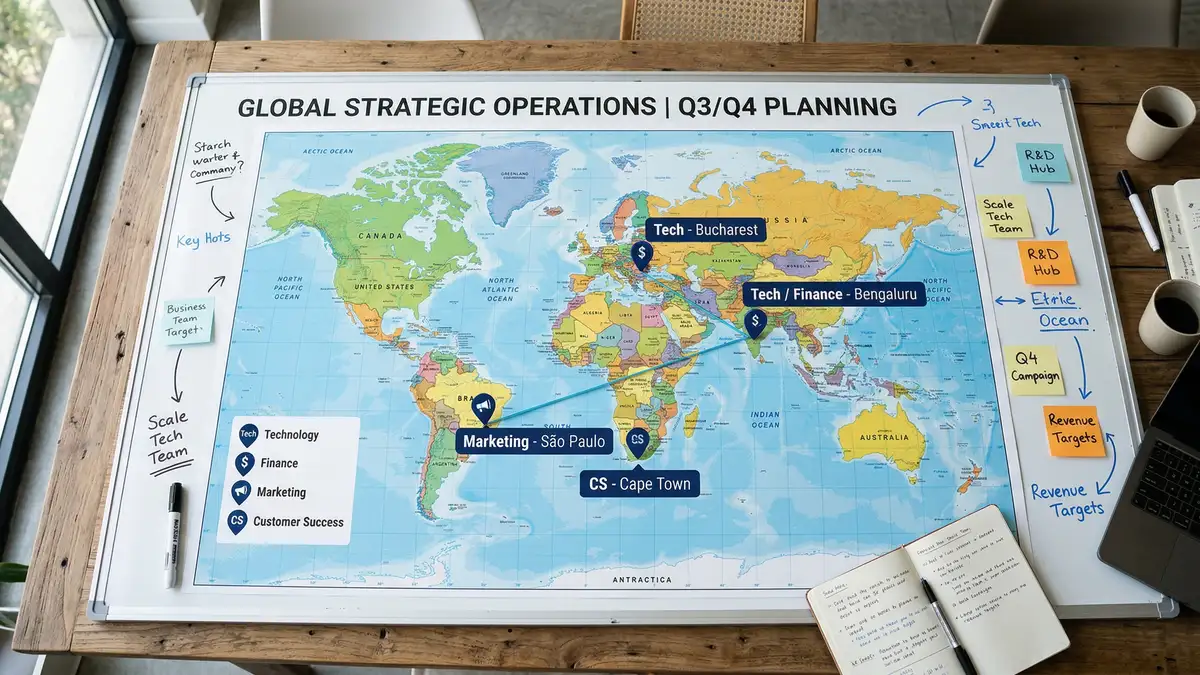
Marketing specialists, content creators, SEO specialists, and demand generation roles work well offshore when supported by clear briefs and brand guidelines. Potentiam's multi-hub network supports all four functions across technology, finance, customer success, and marketing leadership.
How Do You Avoid the Common Pitfalls of Offshore Teams?
The biggest risk with offshore teams is isolation. People shipped offshore without proper structure, governance, or support become disengaged, confused, and likely to leave within 12-18 months. Attrition rates in India hit 17-25% annually. You lose knowledge. You restart hiring. Savings evaporate.
Success requires discipline in four areas: governance, communication, professional development, and HR support.
Governance means clear processes.
Your offshore team needs explicit documentation on how work is requested, reviewed, prioritised, and delivered. Async-first communication (Slack, Jira, email) replaces standup culture because time zones make synchronous meetings exhausting. Create decision frameworks so your offshore team can move without waiting 8-12 hours for a UK manager to respond.
Communication requires over-communication.
Record decisions. Write down context. Share quarterly strategy updates. Schedule monthly all-hands calls (even if ungodly hours for someone). The cost of miscommunication offshore is 10x the cost of over-communicating. Potentiam supports this with an embedded HRBP (Human Resources Business Partner) who works within your team structure, translating strategy and ensuring clarity across hubs.
Professional development keeps people.
Budget training, certifications, and clear promotion paths. Offshore talent want the same career growth as UK employees. If they feel stuck in a junior role forever, they'll leave. Invest in their growth and they'll deliver for years.
Key Takeaway
Embedded offshore teams fail when companies treat them as cost-cutting outsourcees rather than core team members. Success requires governance structure, intentional communication, professional development investment, and dedicated HR support to bridge geography and culture.
Define Governance Upfront
Document how requests flow, decisions are made, and accountability is tracked. Async-first communication beats synchronous meetings across time zones.
Establish an Embedded HR Partner
A dedicated HR support person embedded in your offshore hub bridges culture gaps, handles performance management, and surfaces issues before they escalate.
Invest in Onboarding and Training
Spend 6-8 weeks on structured onboarding. Budget for certifications, tools access, and knowledge sharing. People who feel invested in stay longer.
Communicate Constantly and Over-Communicate
Write down strategy, decisions, and context. Schedule monthly all-hands. Record updates. Clarity prevents confusion across distance.
What Role Does AI Play in the Insource vs Outsource Decision?

AI is reshaping the insource vs outsource equation fundamentally. Junior roles are disappearing. AI handles routine coding, basic data analysis, content drafts, and first-pass customer support. You need fewer junior people and more experienced ones to review, refine, and lead.
This changes hiring incentives. Instead of building 10-person junior-heavy teams, you might build 6-person senior-heavy teams augmented with AI tooling. The fully loaded UK cost of a senior developer (£95,000) now buys you the equivalent of 1.5-2 junior developers (£60,000 each) plus AI tools plus improved quality through seniority.
This makes offshore hiring even more attractive. A senior developer in South Africa at £42,000 plus AI tooling outpaces a UK junior at £45,000. You get experience, better code quality, and mentorship capability from day one. The outsourcing model fails even more here because vendors can't compete on quality when quality increasingly depends on seniority and AI augmentation.
Strategic offshoring with smaller, more experienced teams is becoming the default for growth-focused companies. You scale senior talent offshore at 50-60% UK cost, augment them with AI tools your vendors likely can't afford, and end up with a more capable team than you'd build with in-house juniors.
How Do You Choose the Right Scaling Model for Your Business?
The decision matrix comes down to four questions: How fast do you need to scale? How much control do you need? What functions are you scaling? What's your tolerance for operational complexity?
Choose insourcing if: You're scaling one or two functions that are mission-critical to product. You have strong hiring and people development capabilities. You can afford 8-12 weeks per hire plus 6-7 months onboarding. Control and culture fit are non-negotiable.
Choose outsourcing only if: You need a non-core function handled (catering, facilities, low-skill admin). You're willing to accept lower quality and longer timelines. You have extensive vendor management bandwidth. You expect the engagement to end within 2-3 years. If those conditions don't match, outsourcing will disappoint you.
Choose strategic offshoring if: You need to scale fast (6-12 months). You have 3-5 functions to staff simultaneously. You want direct hiring authority and management control. You're comfortable with some operational complexity (time zones, documentation, HR support). You need sustainable cost reduction (not short-term vendor discounts). You plan to retain the team 3+ years.
| Criteria | Insourcing (UK) | Outsourcing | Strategic Offshoring |
|---|---|---|---|
| Cost per Person/Year | £95,000 | £80,000 | £42,000 |
| Time to Productivity | 6-7 months | Vendor dependent | 8-12 weeks |
| Control and Flexibility | 100% | Low | High |
| Quality Risk | Low (your culture) | High (vendor incentive) | Medium (requires governance) |
| Scalability (10+ people) | Slow | Medium | Fast |
| Operational Overhead | High (recruitment, HR) | Medium (vendor mgmt) | Medium (governance, zones) |
| Knowledge Retention | High | Low (vendor dependency) | High (you own talent) |
| Regulatory/Compliance | UK standard | Vendor managed | Partner managed |
Why Are UK Companies Choosing Strategic Offshoring in 2025-2026?
The trend is unmistakable. Fifty-seven per cent of UK organisations are planning to increase outsourcing and offshoring in 2025. An estimated £3 billion in additional outsourcing spend is flowing into the sector. The global BPO market is projected to reach $525 billion by 2030.
But this growth isn't flowing to traditional outsourcing vendors. Companies are tired of vendor failure. They're building embedded teams instead. The Employer NI changes in April 2025 accelerated the shift; hiring in the UK just became 20-30% more expensive overnight.
Potentiam's multi-hub model positions UK companies to tap four talent pools simultaneously. South Africa offers English-first communication, strong customer success talent, and a growing tech ecosystem. You're hiring in a country where English is the business language and cultural affinity is high. The time zone (GMT+2) provides only 2-4 hours offset, so daily overlap is natural.
Romania provides EU-trained talent with compliance expertise, especially in finance and data privacy. Developers, accountants, and engineers with EU education and GDPR knowledge. Close enough to UK time zones for synchronous work.
India delivers technical excellence and scale. You can build 50-person tech teams in Bangalore at costs impossible in the UK. Attrition and communication require discipline, but the technical talent density is unmatched globally.
Brazil is emerging as a fourth hub, particularly for customer-facing roles. Portuguese and Spanish speakers with strong service culture, ideal for US/LATAM expansion as well as UK operations.
The multi-hub approach is the key differentiator. Companies that build in one hub take all the currency and concentration risk. Companies that build across hubs reduce risk, improve time zone coverage, and develop operational resilience. Potentiam's proven playbook comes from scaling across four hubs simultaneously, learning what works and what doesn't.
This is how serious companies scale in 2025. Not by hiring 20 UK junior developers at £900,000 annual cost with 6-month wait times. By hiring 15 senior developers across four hubs at £550,000 annual cost with 8-10 week speed to market. Better talent, lower cost, lower risk, faster execution.
Frequently Asked Questions
What is the difference between insourcing and outsourcing?
Insourcing means building your own in-house team to handle work. You hire employees directly, manage them, and own accountability. Outsourcing transfers that responsibility to a vendor who manages staff, delivery, and timelines on your behalf. Insourcing gives you control but saddles you with recruiting overhead and fixed payroll. Outsourcing reduces management burden but transfers risk and often sacrifices quality.
How much money can you save by offshoring instead of hiring in the UK?
A senior developer in the UK costs roughly £95,000 fully loaded. The same role in South Africa costs £42,000-£48,000. Romania runs £40,000-£45,000. India ranges £20,000-£28,000. For a 10-person team, shifting from UK hiring to strategic offshoring saves £400,000-£600,000 per year in direct salary. Add avoided Employer NI, recruitment overhead, and onboarding friction, and total savings exceed £500,000 annually at that scale. The savings compound over 3-5 years.
What are the biggest risks of outsourcing for SMEs?
Traditional outsourcing fails 50-70% of the time. Risks include vendor corner-cutting to hit margin targets, communication breakdown across time zones, scope creep leading to hidden costs, quality issues requiring 20%+ rework budgets, and loss of visibility into execution. For SMEs with limited vendor management bandwidth, these risks are acute. The best path for SMEs is strategic offshoring with dedicated HR support, not traditional outsourcing to large vendors.
How long does it take to build an offshore team?
With a strategic partner like Potentiam, the timeline is 8-10 weeks from job posting to productive employee. This includes recruitment (3-4 weeks), offer and onboarding logistics (1-2 weeks), and initial training (3-4 weeks). Compare this to UK hiring, which averages 8 weeks just to hire, then adds 6-7 months onboarding. Offshore teams with proper partner support reach productivity 4-5 months faster than UK hires.
Can you offshore software development without losing quality?
Yes, if you hire experienced developers and invest in governance. Offshore defect density runs slightly higher than onshore (0.7-1.0 bugs per thousand lines of code versus 0.3-0.4) when teams lack structure. But experienced offshore developers match onshore quality when supported by clear code standards, async documentation, and review processes. The key is hiring senior talent (not juniors). A 5-person senior offshore team delivers higher quality than a 10-person junior UK team.
What is the best country for offshoring from the UK?
The answer depends on your function. South Africa excels for customer success, sales support, and tech talent with English-first communication. Romania suits finance, compliance, and EU-regulated roles because of EU training and GDPR expertise. India wins on tech scale and cost, though communication requires discipline. The strongest approach is multi-hub: hire core senior roles in South Africa or Romania, scale tech or customer support in India, and maintain UK presence for senior leadership and client-facing strategy. Potentiam operates across all four hubs precisely because different functions thrive in different places.
Ready to Scale Without the Hiring Headaches?
Potentiam helps mid-sized companies build embedded offshore teams across South Africa, Romania, India, and Brazil, with strategic consulting, dedicated HR, and a proven playbook from operators who scaled to 300+ employees before exit to Accenture.
Sources: Totaljobs 2025 Hiring Report, CIPD UK Employment Trends, Standish Group CHAOS Report, Gartner Outsourcing Research, Deloitte 2024 Outsourcing Trends, McKinsey Skills Gap Analysis how offshore teams drove a £21m exit valuation